

2026 Hyundai IONIQ 5 or 2026 Hyundai IONIQ 9: Which Hyundai EV Fits Your Alberta Family?
2026 Hyundai IONIQ 5 or 2026 Hyundai IONIQ 9: Which Hyundai EV Fits Your Alberta Family?
Posted on July 7, 2026
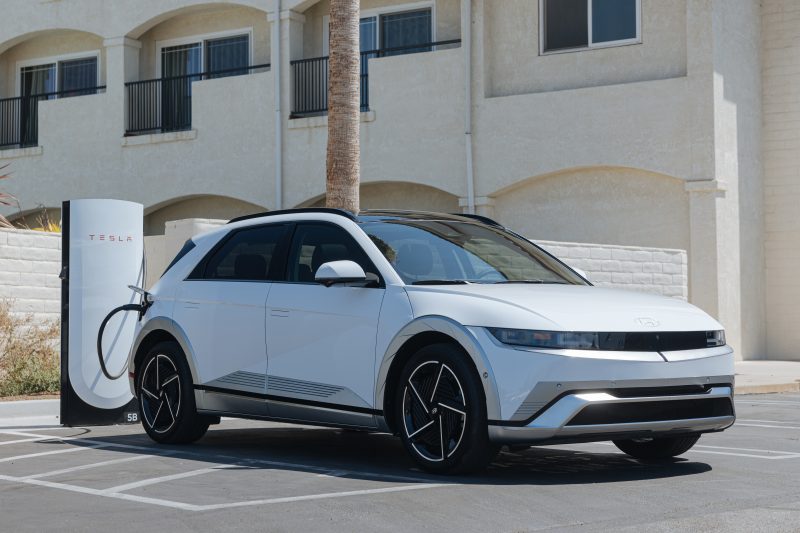
Choosing an electric SUV gets more complicated once car seats, hockey bags, and a second stroller enter the picture. Hyundai’s lineup covers that range with two different answers: the two-row IONIQ 5 and the three-row IONIQ 9. Both are fully electric, both ride on Hyundai’s E-GMP platform, and both are built for Alberta’s mix of city commutes and long highway stretches.
The real question is which cabin, charging setup, and cargo layout actually matches how your family drives. Here’s how the two compare, spec by spec.
IONIQ 5 vs. IONIQ 9: Key Specs Side by Side
| Spec | IONIQ 5 | IONIQ 9 |
| Seating layout | Two-row, 5 seats | Three-row, up to 7 seats (6 in Ultimate Calligraphy) |
| Battery capacity | 84 kWh | 110.3 kWh |
| Longest all-electric range | 504 km (RWD) | 539 km (Essential RWD) |
| DC fast charge, 10-80% | 18 min | 24 min |
| Cargo behind rearmost row | 745 L | 620 L |
| Max cargo, rows folded | 1,655 L | 2,461 L (behind front seats) |
| Ground clearance | 155 mm | 175 mm |
| Max towing | 2,698 lbs (1,224 kg) | 5,000 lbs (2,268 kg) |
Seating, Cargo, and Everyday Family Hauling
The IONIQ 5 keeps things simple with two rows and seating for five. Cargo space behind the rear seats sits at 745 L, enough for a full grocery run and a folded stroller, and it opens to 1,655 L with the 60/40 split second row folded down. A 24 L front trunk keeps charging cables out of the main cargo area.
The IONIQ 9 adds a full third row, with seating for seven in a 2+3+2 layout, or six in the Ultimate Calligraphy’s second-row captain’s chairs with relaxation mode and leg rests. Cargo behind that third row is 620 L on its own, but folding both rear rows opens 2,461 L behind the front seats, plus an 88 L frunk on rear-wheel-drive trims (52 L on AWD models).
For a family of four running errands around town, the IONIQ 5’s cargo hold covers groceries and gear without a bigger vehicle to park. For carpool duty, grandparents along for the ride, or three kids who each need their own seat, the IONIQ 9’s third row and larger folded cargo space carry more people and more stuff at once.
Charging, Range, and Towing for Alberta Trips
The IONIQ 5’s 84 kWh battery carries the rear-wheel-drive version 504 km on a charge, or 463 km with the dual-motor AWD setup. A DC fast charger takes either version from 10 to 80 percent in 18 minutes, and a Level 2 charger fills it in about 7 hours 20 minutes overnight.
The IONIQ 9’s larger 110.3 kWh battery covers more ground: 539 km on the Essential RWD, 515 km on the Preferred AWD, and 500 km on the Ultimate Calligraphy. Despite the bigger battery, a DC fast charger still takes it from 10 to 80 percent in 24 minutes, with a Level 2 charger needing about 9 hours 40 minutes.
Towing is where the gap widens. The IONIQ 5 is rated for 2,698 lbs (1,224 kg) with a braked trailer, enough for a small utility or bike trailer. The IONIQ 9 starts at 3,500 lbs (1,587 kg) on Essential RWD and climbs to 5,000 lbs (2,268 kg) on AWD trims, with trailer prewiring and terrain drive modes for hauling a camper or boat toward the mountains.
Ground Clearance, Winter Traction, and City Parking
Both EVs run a heat pump with battery preconditioning as standard equipment, so cabin heat and battery range hold up through an Alberta winter without draining the pack as fast as a resistive heater would. Dual-motor AWD is available on both models, and the IONIQ 9’s Preferred AWD trims add HTRAC all-wheel drive with terrain drive modes for gravel and snow-covered lots.
Size works in opposite directions here. The IONIQ 9’s 175 mm ground clearance handles snow berms and rough parking lots a little better than the IONIQ 5’s 155 mm. But the IONIQ 5 is the easier vehicle to place: at 4,655 mm long with a 5.99 m turning circle, it slots into tight parkade stalls and school pickup lanes more easily than the 5,060 mm IONIQ 9, which turns in a wider 6.25 m circle.
A daily driver doing school runs and grocery trips in the city leans toward the IONIQ 5’s smaller footprint. A vehicle that spends more time loaded with passengers on the highway benefits from the IONIQ 9’s extra clearance and stability instead.
Which Hyundai EV Fits Your Drive?
If you’re a smaller family or couple who wants one EV for commuting, weekend trips, and the occasional cargo run, the IONIQ 5 works because its two-row layout is easier to park, charges to 80 percent in 18 minutes, and still holds 1,655 L of cargo with the seats down.
If your household is running carpool duty, hosting grandparents on visits, or needs a seat for every kid’s friend on a road trip, the IONIQ 9 works because its three-row layout seats up to seven, tows up to 5,000 lbs (2,268 kg), and keeps 620 L of cargo available even with all seats in use.
For a family that mostly drives around town and occasionally tows a small trailer, the IONIQ 5’s charging speed and turning radius matter more than a third row. For a family regularly hauling passengers and gear across Alberta, the IONIQ 9’s seating and towing capacity change the math.
Two Electric SUVs, One Hyundai Showroom
The IONIQ 5 and IONIQ 9 solve different daily problems: one prioritizes agility and fast charging, the other prioritizes seating and cargo room for a growing family. Both share Hyundai’s E-GMP platform, an 800V-capable charging architecture, and standard battery preconditioning for winter driving.
Visit Crowfoot Hyundai in Calgary to sit in both cabins, check second-row access, and load your own gear into the cargo area, then compare charging and towing details on the model that fits your family best.