

2026 Hyundai Tucson or 2026 Hyundai Santa Fe: Comparing Space and Fuel Efficiency in Alberta
2026 Hyundai Tucson or 2026 Hyundai Santa Fe: Comparing Space and Fuel Efficiency in Alberta
Posted on July 17, 2026
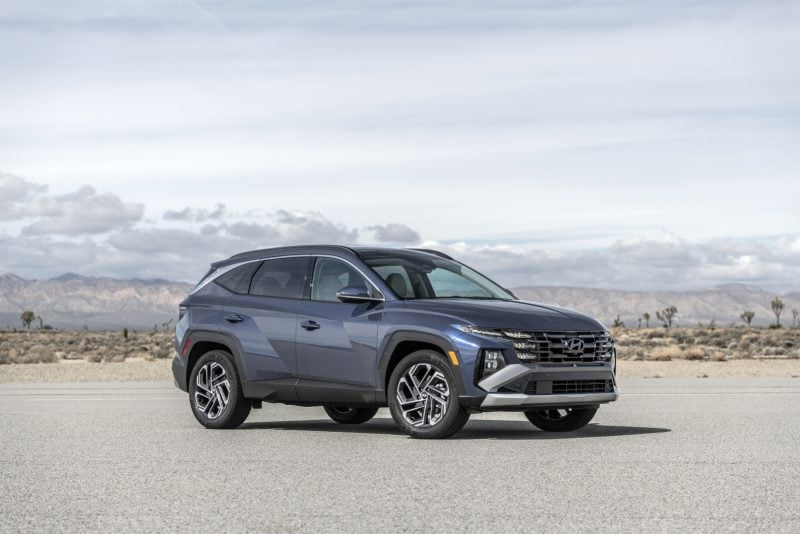
Choosing between two Hyundai SUVs sounds like a bigger decision than it is. The 2026 Tucson and Santa Fe are both built for Alberta roads, but they solve different problems for different households. One keeps daily errands simple. The other carries a growing family, and everything that comes with it.
This comparison sets price aside and looks at what actually changes week to week: how many people fit, how much gear goes in the back, and how each SUV feels behind the wheel. The right answer depends on your routine, not on which name sounds bigger.
Tucson vs Santa Fe: The Numbers Side by Side
| Spec | Tucson | Santa Fe |
| Drivetrain | AWD (all trims) | AWD (all trims) |
| Seating capacity | 5 | 7 (6 with second-row captain’s chairs) |
| Cargo, seats up | 1,095-1,097 L (gas/hybrid), 902 L (plug-in hybrid) | 1,148 L (behind 2nd row), 413 L (behind 3rd row) |
| Cargo, seats folded | 2,108-2,119 L (gas/hybrid), 1,876 L (plug-in hybrid) | 2,267 L |
| Ground clearance | 210 mm | 177 mm |
| Combined fuel economy | 8.8 L/100km (2.5L gas), 6.7 L/100km (hybrid) | 6.9 L/100km (hybrid) |
| Horsepower | 187 hp (2.5L), 231 hp (hybrid), 268 hp (plug-in hybrid) | 231 hp (hybrid) |
Seating and Second-Row Space for Family Life
The Tucson seats five, with front legroom of 1,052 mm and rear legroom of 1,050 mm. That’s a comfortable amount of room for two adults and two or three kids, without a third row to manage or store.
The Santa Fe seats seven across most trims, or six with second-row captain’s chairs in its top configuration. Second-row legroom measures 1,075 mm, even more than the front row’s 1,052 mm, so middle-row passengers stretch out on longer drives.
The Santa Fe’s third row measures 761 mm of legroom, tight enough that it suits kids or short trips better than adults on a long drive. It still turns a five-seat cabin into a genuine seven-seat one for carpools or extra passengers.
Cargo Flexibility for Everyday Hauling
With all seats up, the Tucson holds 1,095 to 1,097 litres behind the second row on gas and hybrid models, or 902 litres on the plug-in hybrid, whose battery pack claims some floor space. Fold the second row down and that grows to 2,108 to 2,119 litres, or 1,876 litres on the plug-in hybrid.
The Santa Fe carries 413 litres behind its third row, room for groceries and a couple of duffel bags even with seven seats in use. Fold the third row and cargo space grows to 1,148 litres. Fold both rear rows and it reaches 2,267 litres, more space than the Tucson offers with its seats folded.
Both SUVs use 60/40 split-folding rear seatbacks and under-floor storage for smaller items. The difference comes down to strategy: the Tucson’s cargo area works one way, folded or not, while the Santa Fe’s three rows let you dial in exactly how much seating versus cargo space a trip needs.
Powertrain and Efficiency for Every Commute
The Tucson offers three paths to AWD efficiency. The 2.5-litre four-cylinder gas engine makes 187 hp and 178 lb-ft, with combined fuel economy of 8.8 L/100km, a straightforward option for buyers who want a simple fill-up routine.
The 1.6-litre turbo hybrid four-cylinder makes 231 hp and 271 lb-ft combined, dropping combined fuel economy to 6.7 L/100km without ever needing a plug. A 1.6-litre turbo plug-in hybrid variant adds a 13.8 kWh battery for 51 km of all-electric range, using a 7.2 kW onboard charger, and still returns 6.7 L/100km in combined gas-electric driving once the battery runs low.
The Santa Fe simplifies the choice: every trim runs the same 1.6-litre turbo hybrid four-cylinder, at 231 hp and 271 lb-ft, delivering 6.9 L/100km combined. That’s efficiency nearly identical to the Tucson’s hybrid, carried in a larger, three-row SUV. Buyers who want one hybrid powertrain and no configuration decisions get exactly that.
Everyday Manoeuvrability and Parking
The Tucson measures 4,640 mm long and 1,865 mm wide, on a 2,755 mm wheelbase. The Santa Fe stretches to 4,830 mm long and 1,900 mm wide, on a longer 2,815 mm wheelbase to support its extra row of seats.
That size gap matters in tight parking stalls and narrow lanes. The Tucson’s smaller footprint makes it easier to place, back into, and manoeuvre through everyday errands. The Santa Fe asks for a bit more room, a fair trade for the extra seating and cargo space it carries.
Both SUVs come standard with HTRAC all-wheel drive across every trim. The Tucson’s 210 mm of ground clearance is higher than the Santa Fe’s 177 mm, giving it a bit more room over rutted gravel roads or snow-packed side streets, useful year-round across Alberta.
Which Hyundai Fits Your Drive?
If your week is built around commuting, errands, and parking in tight spaces, the Tucson is the right fit. Its smaller footprint, 187 to 268 hp range of powertrains, and fuel economy as low as 6.7 L/100km suit a couple or small family that wants efficiency without giving up cargo room.
If your household is growing, if car seats and carpools and hockey bags are part of the routine, the Santa Fe is the right fit. Its seven-passenger layout, 2,267 litres of folded cargo space, and one straightforward hybrid powertrain suit a family that needs the extra row more than it needs a smaller parking footprint.
- Tucson fits: commuters, couples, and small families prioritizing manoeuvrability and fuel economy.
- Santa Fe fits: growing families needing a third row, more cargo flexibility, and one simple hybrid powertrain.
Both share the same AWD system and the same 231 hp hybrid engine option. The difference isn’t which Hyundai is stronger. It’s which layout matches how your family actually uses an SUV.
Finding the Right Hyundai for Your Household
The 2026 Tucson and Santa Fe both pair standard AWD with efficient hybrid options, but each is built around a different shape of family life. The Tucson favours compact efficiency and easy parking. The Santa Fe favours passenger space and cargo flexibility.
Visit Crowfoot Hyundai in Calgary to sit in both cabins, check the cargo area and seating layout of each SUV, and talk through which powertrain matches your daily commute and family size.